
Logan County Probate Records Overview
Logan County probate matters are handled in the Probate Division of the District Court. The local District Court page says Kansas District Courts have power over probate and administration of estates, guardianships, and conservatorship cases. That puts Logan County estate files, will filings after death, small-estate proceedings where Kansas law allows, and guardianship or conservatorship cases in the same court system that handles civil, criminal, domestic, small claims, traffic, and protection-order work.
Probate records can be useful for heirs, creditors, title work, family-history research, guardianship questions, fiduciary proof, and certified court orders. A case file may include a will, petition, inventory, accounting, notice, order, letters testamentary, letters of administration, creditor claims, bond information, and final settlement documents. Public case information may be visible through Kansas CaseSearch, but filed documents may need courthouse terminal access or a written request to the Logan County Clerk of the District Court.
Logan County Probate Terms
Probate files use short legal labels. Knowing the labels helps when searching by name, asking for the correct certified copy, or reading a docket entry in a Logan County District Court case.
- Testator
- A person who made a will.
- Executor
- The person named to carry out a will, when appointed by the court.
- Intestate
- Dying without a valid will, which means Kansas law controls who may inherit.
- Guardianship
- A court case about personal care or decision-making for a minor or adult.
- Conservatorship
- A court case about control or protection of money, property, or financial affairs.
- Letters
- Certified court authority showing who may act for an estate.
Search Logan County Probate Records
Start with Kansas CaseSearch when public case information is enough. The official CaseSearch instructions say a case number or name is required, and date of birth may narrow party searches. Probate name searches may involve the decedent, petitioner, guardian, conservator, conservatee, or other party, so exact names and approximate dates help. If the portal does not show the public record, the 15th Judicial District records page says public records not available through the portal are available at the courthouse.
- Search by case number if the probate case number is known.
- Search by name if the case number is not known, using the decedent or party name.
- Confirm the court is Logan County District Court before relying on the result.
- Use the courthouse terminal for public records that do not appear online.
- Submit a written request to the Clerk of the District Court for documents or certified copies.
| Field Label | Type | Required | Notes |
|---|---|---|---|
| Case number | Text | Required if not using name | Use CaseSearch or include it in the clerk request. |
| Name | Text | Required if not using case number | May be decedent, petitioner, guardian, conservatee, or party name. |
| Date of birth | Date | Optional | May narrow party results in CaseSearch. |
| County or court | Filter/context | If available | Use Logan County District Court. |
Logan County Probate Court Contact
There is one researched Logan County probate venue: the Probate Division of the District Court at the Logan County Courthouse in Oakley. The Clerk of the District Court is the custodian contact for probate case files, certified copies of probate orders, courthouse public-access terminal help, and written requests. Probate questions about forms and state procedure can also use the Kansas Judicial Council probate forms resource.
Probate Division of the District Court
Logan County Courthouse
710 W. 2nd Street
Oakley, KS 67748
785-671-3654
Email: lgdc@kscourts.gov
Fax: 785-671-3517
K.S.A. 59-1507b is the Kansas small-estates affidavit statute.
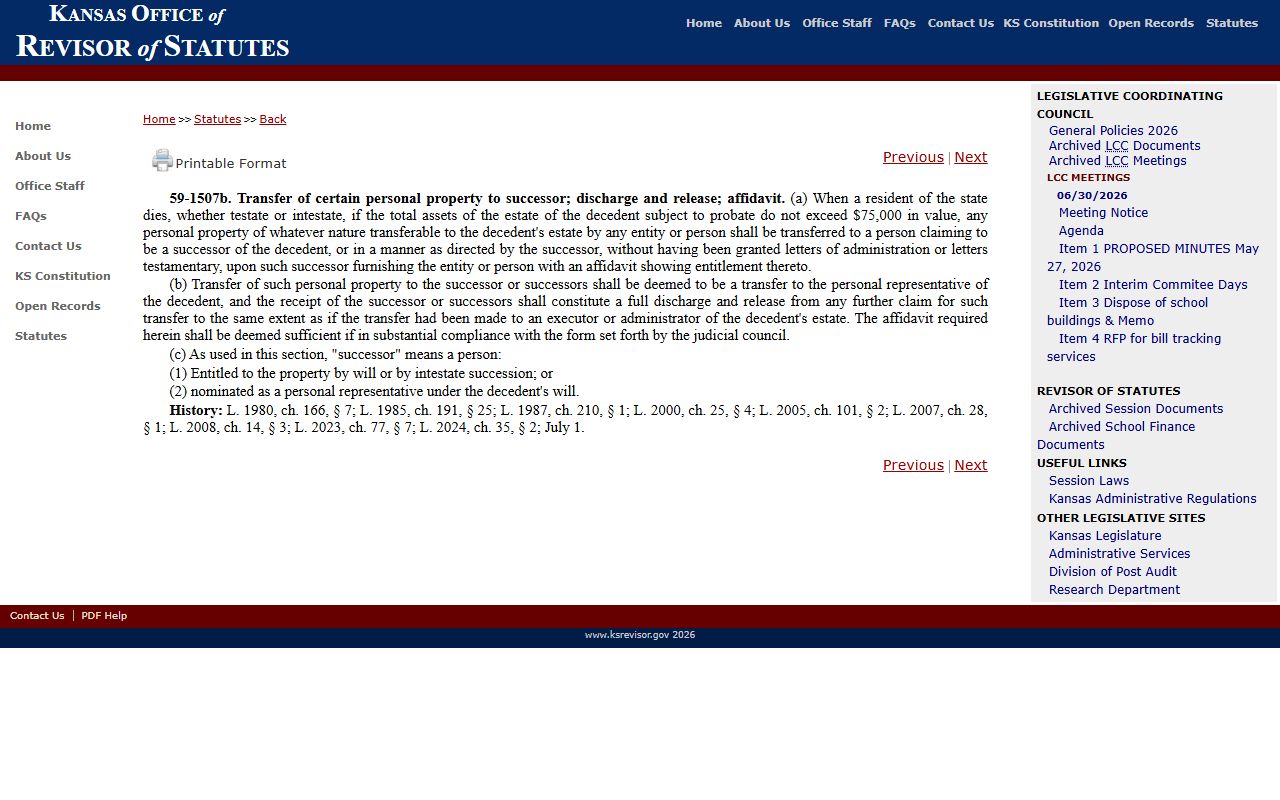
Small-estate affidavits can be relevant in Kansas, but Logan County probate users should confirm the current threshold and conditions from the statute or official forms before relying on that simplified path.
Logan County Probate Fees
Official Logan County and 15th Judicial District sources did not publish a local probate fee schedule in the research file. That gap should be handled directly: ask the Clerk of the District Court for the current filing cost, copy cost, certification charge, and any staff-time estimate before submitting a request. The district records page does confirm that reasonable fees and expenses may be charged for court-record requests and that costs must be paid before the record is released.
| Probate fee | Amount / rule |
|---|---|
| Logan County probate filing fees | Not located in official Logan County research |
| Plain copies | Not located in official Logan County research |
| Certified copies | Not located in official Logan County research |
| Staff time and open-records expenses | Reasonable fees and expenses may be charged under district request rules |
| Third-party electronic-record help | Third-party charges may be imposed when needed to respond |
Note: Fee amounts that are not published should be confirmed before mailing payment or expecting a certified probate copy.
What Logan County Probate Records Show
A Logan County probate record can show the case number, court, parties, fiduciary names, filings, notices, hearings, orders, and document history. Estate cases may include a will, petition for probate, petition for administration, inventory, accounting, creditor claim, final settlement, and letters showing authority to act for the estate. Guardianship and conservatorship files may include petitions, orders appointing a guardian or conservator, accountings, review hearings, and later modification orders.
The case summary is not the same as the full file. The 15th Judicial District distinguishes case information from court records. Case information is the summary, including case number, case type, people involved, attorneys, assigned judge, and hearing dates. Court records are the actual filed documents. For many Logan County probate needs, a person may find the existence of the case online but still need to request the order, letters, or certified copy from the clerk.
Older Logan County estate research can also be affected by courthouse history. Official county history says all county records moved from Russell Springs to Oakley on August 13, 1963, after the county-seat dispute ended. That does not create a separate probate court, but it helps explain why older probate records may be tied to the earlier county-seat era while current access runs through the Oakley courthouse.
Restricted Logan County Probate Details
Not every probate-related filing is fully public online. Guardianship, conservatorship, minor information, medical details, financial account information, and sealed material may be redacted, restricted, or available only by court order. Kansas Supreme Court Rule 22 controls public electronic access to district court records, and KORA exemptions may also affect disclosure. The court clerk can provide public access but cannot release sealed or confidential records just because a person asks for them.
The practical fallback chain is simple. Search the public portal first, use the courthouse terminal when a public record is not online, and submit a written request when copies or certified probate records are needed. If the response says a record is sealed, restricted, or unavailable through public access, the next step is usually a court order or legal advice, not a broader web search.